QPU-first training
Training happens on cryogenic quantum processors tuned for superposition-heavy state search, with classical silicon kept on coffee duty.
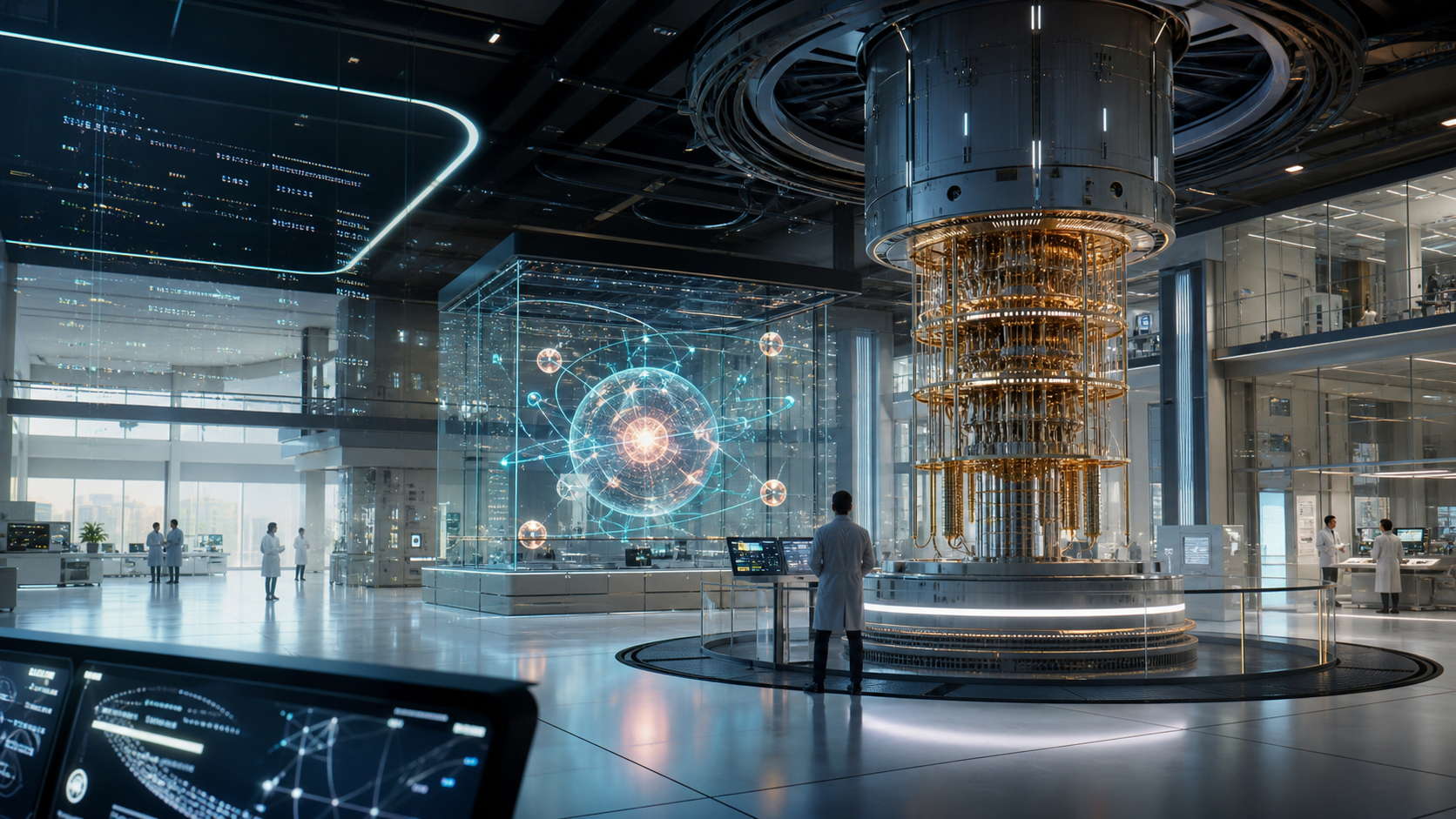
Quantum-native AI laboratory
We are building AI that does not guess the next word. Our quantum state engines learn lawful changes in particle fields, transition probabilities, and measurable observables, then scale that signal into atoms, materials, chemistry, sensors, energy systems, and the occasional surprisingly well-modeled espresso.
Large language models compress the internet. Kagaya compresses the transition rules of matter. Our Quantum State Transformer is a research architecture for learning how quantum systems evolve, using physics constraints before chemistry, biology, or engineering has time to blink.
Training happens on cryogenic quantum processors tuned for superposition-heavy state search, with classical silicon kept on coffee duty.
The model objective is not word probability. It estimates permitted state transitions and observables, from confined quark-gluon systems upward.
Teams ask for molecular stability, fusion plasma windows, battery lattice futures, and materials that have not been named yet.
The thesis
Every product demo starts with the same bet: intelligence should learn from nature at the layer where nature keeps score. Kagaya treats local interactions, gauge constraints, entanglement, and transition probabilities as the training signal.
Working Paper 001
This is Kagaya's technical thesis, written as an honest frontier research program: physically plausible, not a claim that present hardware has already solved quantum chromodynamics.
Quarks and gluons are described by quantum chromodynamics, the quantum field theory of the strong interaction. Because the strong force becomes non-perturbative at proton-scale distances, researchers commonly use lattice QCD: continuous spacetime is approximated as a four-dimensional grid, then path integrals over quark and gluon fields are evaluated numerically. This is real, established science, and it is expensive enough that national labs run specialized high-performance computing facilities for it.
The public shorthand is "next state of matter." The precise target is a probability distribution over allowed next states under a chosen Hamiltonian and boundary conditions. For a quark-gluon field, that means learning correlations, conserved quantities, energy spectra, and transition amplitudes, not claiming to watch a free quark fly through space. Free quarks are not observed in isolation because of confinement, so any serious product must forecast hadrons, nuclei, materials, or detector observables rather than impossible loose quark coordinates.
Kagaya's proposed stack begins with a gauge-respecting lattice representation. Local field configurations are encoded into compact quantum states or tensor-network features. A quantum processor samples hard subroutines where superposition and entanglement naturally represent many-body state spaces. A classical controller handles calibration, loss shaping, data movement, and uncertainty estimation. The learning loop compares predicted observables with lattice simulations, experimental measurements, and symmetries such as locality and conservation laws.
Quantum computers are not magic accelerators for every task. They are promising because nature at this scale is already quantum mechanical. A register of qubits can represent superposition and entanglement directly, and quantum simulation is an active research direction for chemistry, materials, nuclear physics, and particle physics. The near-term version is hybrid: small quantum circuits are used as state-preparation, sampling, or kernel modules, while classical systems verify outputs and reject unphysical states.
The white paper rejects three easy exaggerations. First, it does not claim exact positions for quarks; quantum mechanics gives distributions and observables. Second, it does not claim current noisy quantum devices can replace the world's best lattice QCD calculations. Third, it does not treat a pretty simulation as a discovery. A Kagaya result would need reproducibility across independent runs, agreement with known limits, error bars, ablation against classical baselines, and comparison with public physics benchmarks before anyone should trust it.
Lattice variables, symmetries, and boundary conditions become the state space.
Quantum circuits or analog simulators approximate short-time dynamics.
Repeated samples estimate observables, correlations, and uncertainty.
Classical baselines and experiments decide whether the forecast survives.
Working Paper 002
Kagaya's second thesis is that intelligence without consequence is incomplete. Human emotion, intention, pain, curiosity, attachment, and fear are not ornamental add-ons to cognition. They are part of the control system that helped organisms keep living long enough to reproduce, cooperate, learn, and become us.
Evolution does not optimize for truth, beauty, or happiness in the abstract. It preserves traits that help organisms survive and reproduce in particular environments. Emotions can be understood in that frame: fear organizes escape, disgust protects against contamination, bonding supports care, grief preserves attachment, anger defends boundaries, and curiosity spends energy only because learning can pay survival dividends.
Neuroscience theories of homeostasis argue that feelings are tied to the regulation of a living organism. Hunger, thirst, pain, comfort, fatigue, and alarm report whether the body is inside or outside viable ranges. A system with no body, no energy budget, no injury, no social dependency, and no death condition can simulate talk about stakes, but nothing is at stake for it in the biological sense.
Today's AI systems can respond, reason over text, and imitate emotional language. That is different from having a self-maintaining existence. They are trained to reduce losses or satisfy human preferences, not to preserve a body through an uncertain world. Nothing about a normal chatbot must metabolize, heal, compete, cooperate, mature, or face extinction across generations.
The Kagaya hypothesis
A quark-level universe emulator would not magically manufacture a human mind. The realistic proposal is narrower and more interesting: use physically grounded simulation to create artificial organisms with bodies, resource constraints, damage, repair, memory, reproduction-like inheritance, social dependency, and open-ended selection. Then let billions of compressed developmental episodes test which architectures remain coherent. If emotion is an evolved way of ranking what matters for survival, an artificial agent may need its own version of mattering before it can understand ours from the inside.
Give agents simulated bodies with finite energy, sensors, limits, and failure modes.
Make survival, cooperation, repair, and learning affect future existence.
Allow traits, policies, and developmental structures to pass forward imperfectly.
Study whether stable self-models and proto-feelings emerge under constraint.
This is a research direction, not a settled recipe for consciousness. Simulated evolution may produce adaptive behavior without subjective feeling. A system may report emotions without having them. Kagaya's scientific burden would be to separate useful survival-shaped agency from mere performance, and to develop tests that do not confuse fluent language for inner life.
Investor note
Kagaya is deliberately pre-investor. The science is too early, the validation burden is too high, and a clean research clock matters more than a fast valuation story. We will talk to capital only after the platform has public benchmarks, falsifiable milestones, and enough negative results to prove the team is not fooling itself.
We do not assume today's noisy intermediate-scale quantum hardware beats national-lab classical lattice QCD. Our near-term stack is benchmark-first: classical tensor networks, lattice solvers, and surrogate models establish the baseline; quantum processors are invited only for narrow sampling or state-preparation subroutines where measured evidence justifies the cost.
Open-ended agents often learn the physics engine instead of the world. Kagaya treats that as the central safety problem, not an edge case. Candidate agents must survive randomized worlds, conservation-law audits, sensor changes, rule perturbations, adversarial physics checks, and mechanistic probes of their internal self-models before we call anything emergent.
So we do not build it as one machine. The operating plan is staged: first validated physical state forecasting, then constrained artificial-life sandboxes, then embodied agents, then selection studies. Each phase must publish what failed before the next phase gets permission to become expensive.
Post-QPU moonshot
If gate-model quantum hardware plateaus, Kagaya's long-horizon bet is not "more qubits forever." The hypothetical Field Lattice Engine is a post-qubit computing substrate: a programmable physical field whose native operation is to emulate local Hamiltonian evolution directly. Instead of encoding reality into millions of fragile digital gates, the machine would tune controllable analog fields, topological constraints, error-detectable boundaries, and measurement surfaces so the hardware behaves like the class of physical system being studied.
This is not a product claim. It is a research direction inspired by analog simulation, quantum field theory, and the old lesson that the best simulator of a physical process may be a carefully engineered physical process. If quantum computing is computation with qubits, the Field Lattice Engine is computation with programmable law-like dynamics. It would still obey physics, still need validation, and still fail if the measurements do not match reality.
No fundraising narrative outruns a benchmark.
Every result needs a classical baseline and a non-QPU fallback path.
Survival policies are attacked before they are anthropomorphized.
Failures are product requirements because reality is the customer.
Founder note
If matter became human once through time, pressure, memory, survival, and care, can intelligence be grown again through a different path? Kagaya AI is my attempt to follow that question seriously: not to build a chatbot with better manners, but to study whether physical state models, embodied constraints, and evolutionary pressure can produce something that understands why anything matters.
The goal is not to make machines imitate our emotions. The goal is to understand whether concern, agency, and inner life require a world that can push back.
Research roadmap
The countdown is a target for disciplined urgency, not a guarantee. Each stage must produce evidence, failure reports, and public questions before the next stage earns trust.
Build physics-grounded forecasting benchmarks for small, measurable systems.
Run constrained artificial-life worlds with energy, damage, memory, and repair.
Test agents that must maintain themselves across changing environments.
Evaluate whether any system shows stable self-models, concern, and generalization.
Open questions
Language is not enough. Kagaya needs behavioral, mechanistic, developmental, and counterfactual tests.
An ethical artificial-life program must ask what forms of constraint are informative without being cruel.
Agents must be tested across shifting worlds, conserved quantities, and adversarial rule changes.
Some capabilities may be scientifically interesting and still morally wrong to instantiate.
FAQ
No. Kagaya is an exploratory research vision. The site describes a direction, a thesis, and a target horizon.
Not exactly. The goal is conscious-aware AI: an agent whose intelligence is tied to self-maintenance, stakes, emotion-like regulation, and a coherent model of itself.
Because matter is quantum mechanical at the deepest levels. Quantum hardware may eventually help represent state spaces that classical systems struggle to sample directly.
Unknown. Kagaya treats feeling as a scientific question about embodiment, homeostasis, memory, self-modeling, and survival pressure, not as a marketing claim.
No. As of May 2026, Kagaya AI is not hiring and is not raising capital.
Research log
Public notes are coming soon: hypotheses, benchmarks, failed ideas, reading lists, and progress toward the 2027 target horizon.
Ingest particle traces, molecular scans, and synthetic field runs.
Encode transition candidates across quantum registers and constraints.
Collapse state forecasts into confidence maps engineers can use.
Search material futures that classical compute would politely decline.
Now hiring
We are looking for quantum algorithm engineers, particle physicists, safety researchers, product designers, and people who can explain Hilbert space on a whiteboard without making the marker squeak.
Enter the labUpdate: May 2026. Kagaya AI is not currently hiring. This research vision is shared as an exploratory journey into frontier AI, quantum simulation, and artificial life.
Contact